Pages

Thursday, October 7, 2010

Reading with Young Children

This is another compiled list of handouts I have accumulated about books and reading with your chidren.
Some of it is obvious, but it does have some good suggestions for improvement.
Reading with Young Children
The goal of reading to children is for them to gain a lifelong love of books.

Make reading out loud to children a daily ritual: 


  • Choose the same time and place, and make it a high priority.


  • Choose a quiet area that is free of distractions; with soft, comfortable, well-lit surroundings.


  • One of our major goals as parents is to teach our children how to communicate effectively. This includes reading, writing, speaking and listening. Reading aloud strenghens these communication skills.
Introduce the book:


  • Introduce the title, author, illustrator, and book cover.


  • Ask questions: What do they thnk the book will be about?
Look at the pictures:


  • What does the picture tell?


  • Have your younger children try and tell you what the story is about simply by looking at the pictures.
Use facial expressions and body movements:


  • Model your excitement for reading.


  • Rather than sitting your child on your lap facing the same direction, turn them around and hold the book under your chin. They still get to see the book, but they also get to see you (your expressions, how you pronounce words, etc.)
Change your voice for different characters:


  • The tone of your voice should express the characters' feelings.


  • Your coice should sound exciting and interesting
Talk about the story:


  • What do they think will happen?


  • Encourage them to ask questions.
Keep children involved and excited:


  • Some children may need to act out the story.


  • Use puppets with children who need to develop their listening skills.
Make sure the book is interesting to the children:


  • Can they relate to the characters?


  • Choose books with limited text and engaging pictures.
Read favorite books over and over again:


  • The repetition supports word recognition.
Why Read to your Child?


  • Strengthen communication skills: reading, writing, speaking.


  • To build a positive relationship with books and reading; giving your child a desire to read


  • To help children learn to read more easily and confidently when the time comes (without pushing)


  • To improve listening skills


  • To expand vocabulary


  • To teach more complex sentence structure


  • To improve memory


  • To provide a setting for warmth, attention, security, and sometimes a calming break in tensions


  • To expand a child's understanding of himself; arousing imagination, emotions and sympathies


  • To expand a child's understanding of his world; promoting discussion of both the commonplace and the extraordinary.


  • To strengthen reader's relationship with the child; helping understand each other through reactions to and discussion of boks.


  • For fun.
Books for Different Ages:
Infants:


  •  Sturdy board books babies can chew on


  •  Books without words


  •  Books of babies


  •  Books about everyday objets (food, toys, animals, etc.)


  •  Books containing photos of familiar people
Toddlers:


  •  Sturdy books that can be carried and dropped


  •  Books with few words


  •  Books of familiar activities (playing, eating, sleeping, etc.)


  •  Bedtime books


  •  Books about going places


  •  Books with simple rhymes and predicatble texts


  •  Books of familiar songs
Pre-Schoolers:


  • Books with more words that tell stories (with lots of pitures but only a few sentences on the page)


  • Books about children with similar experiences (going to preschool, spending the night at a friend's house, going to the doctor, etc.)


  • Books about friends


  • Books about families


  • Books with predictable story lines and repeated phrases

Thursday, September 30, 2010

Milk Jug Catch

This is a really easy game that comes together quickly.
My boys loved it.

Milk Jug Catch

Materials Needed:
- Washed out Milk Jugs
- String or Yarn
- Scissors
- Squishy Balls

Start by cutting off the bottom half of your milk jugs.

Make sure the handle is still in tact.

Using your scissors, poke a hole just under the spout.
 Run your string through and tie a knot.

Then tie the othr end around your ball.

And you're done!


The idea is to swing the ball and catch it in the carton.
It is surprisingly hard for a 4 year old, so he cheats...


This has actually turned out to be a bigger success than I thought.  We don't go anywhere without his 'squishy ball' these days.

Have fun!

Thursday, September 23, 2010

Camping at Albion

The in-laws go on an annual camping trip.
We went to Albion Campground just above Alta and Brighton Ski Resorts this year.

We stayed in campground #10.
The best part?
The moose that lives in gampground #12.

He was a daily occurance, with an occasional glimpse of the mommy and baby.


Even though it happened to snow on us, the boys had a great time.


We took one day to hike to Cecret Lake.
The trail is very wide and my two year old made it almost the entire way on foot.


We turned around near the top (ran out of time), but it was definitely good enough to go back.
Sorry for the lack of pictures, though.

However, on the way down we of course saw the moose again...


So, if you are looking for a beautiful camping spot, or just a day to go hiking, Albion would be a great choice.

Here's how to get there:
Make your way up the canyon to Alta ski resort.
Stay on that road, passing Alta, and follow it all the way up to the top.
There is a ranger station just after the resort, if you need directions.

Have fun!

Friday, September 17, 2010

Pasta Counting

This is a quick numbers and counting activity that lets your kid be a little crafty at the same time.
Pasta Counting
 

Materials Needed:
 
- Dried Pasta
- Large piece cardboard
- Markers
- Glue

Start by dividing your cardboard into sections (how high you want to count).

 I left a space for him to write his name at the top, and then I used a pencil to write the numbers down the side so he could trace them.


Then just glue a dot for each piece of pasta and stick them on, counting as you go.


This actually helped a lot more than I thought it would.
Cannon is really good at recognizing numbers, but has a harder time with actually counting.
This was a good way to let him figure it out hands on.

Thursday, September 16, 2010

Turn-Taking with Communication

Another helpful handout combined with personal notes I received from a class at Kids on the Move.
This talks specifically about how to use 'turn-taking' to encourage communication with your children.

Conversation: Turn-Taking with Communication

When we talk about conversations, we are really saying that we take turns listening to and talking with our conversational partner about our daily experiences, feelings and ideas - we are taking turns as we communicate.  Interactive turn-taking is a foundation to prepare for more mature conversations.  It helps to develop the habit of attending to and responding to each other in turns.  Turn-taking can be practiced with your actions and voice, like blinking your eyes, imitating gestures, putting toys in a box or playing with cooing, babbling, or animal sounds.  Through turn-taking you build a "give-and-take" relationship in a conversational style.

A basic assumption of language is that the child learns to communicate and acquire speech and language during all daily interactions and conversation with you.  The child's receptive and expressive language grows through watching, listening and having conversational turns with you about what is important.  Thus, the more turn-taking and conversations you do together the more the child will learn how to communicate and acquire speech and language.

My Turn / Your Turn
Here are 3 strategies to help your child communicate more effectively by taking turns.


  1. Follow Your Child's Lead

    • Give your child a chance to communicate

    • Stop and watch your child

    • Do what your child does; imitate your child in whatever activity they are doing

  2. Keep It Going

    • Put yourself down at your child's physical level

      • Get down to eye level - they wont feel so overwhelmed, and they'll recognize that you are paying attention to them

    • Try not to anticipate your child's needs (play dumb)

      • Give them a chance to initiate interaction

      • By playing dumb, you are forcing your child to communicate, rather than just providing them all of their needs.  Pretend not to know what they want.

      • Its all about timing.  You want to challenge your child, but don't force them over the edge into a tantrum.  Once your child is tantruming, they are past the 'teachable' point.

    • Watch and listen carefully

      • Feel the need to respond to whatever sound/imitation they do (forces them into interaction)

        • Their attempts may be small or hard to recognize, so pay attention

      • Reaching, looking, and making a noise are all attempts at interaction

    • Give meaning to their initiations

      • Respond as much as possible.

      • If you don't understand what your child is saying, don't reply with "oh, really?", or "ok", etc.  These phrases don't give meaning to anything.  Instead:

      • Turn their actions/words into something.

        • For example: if baby is babbling "ba, ba, ba", you say, "ba, ba, ba, baby!", or "yep, here is a book".  Always make it meaningful.

  3. Help Your Child Go Further

    • Things that may discourage your child from taking a turn

      • Caregiver taking too many turns (uninterupted repetition)

        • Don't be afraid to wait

        • Expect a response from your child when it is their turn

        • Say "do you want more?"... and look at them like you expect an answer.  It may take time for them to process what you are asking.  Wait 2-5 seconds, and if they don't respond, say something like "yep, here is some more".

      • Doing the activity at a different level than your child

      • Not sharing a topic with your child

      • Not attending to quiet turns

Thursday, September 9, 2010

Cereal Box Characters

Cannon has reached the point of make believe friends.
Mostly they consist of his Uncle McKell (who just left for 2 years), and "kids" as he calls them.
He plays with his fire truck saying things like "get out of the truck please Uncle McKell.  Thank you.  Okay kids, get in the truck."
It is very entertaining in and of itself, but I was throwing out some cereal boxes and noticed they had quiet a few characters on them.
I thought I'd provide Cannon with some alternates; to go along with the imaginary friends...

Cereal Box Characters

These came together really quickly.
First, cut out your characters:

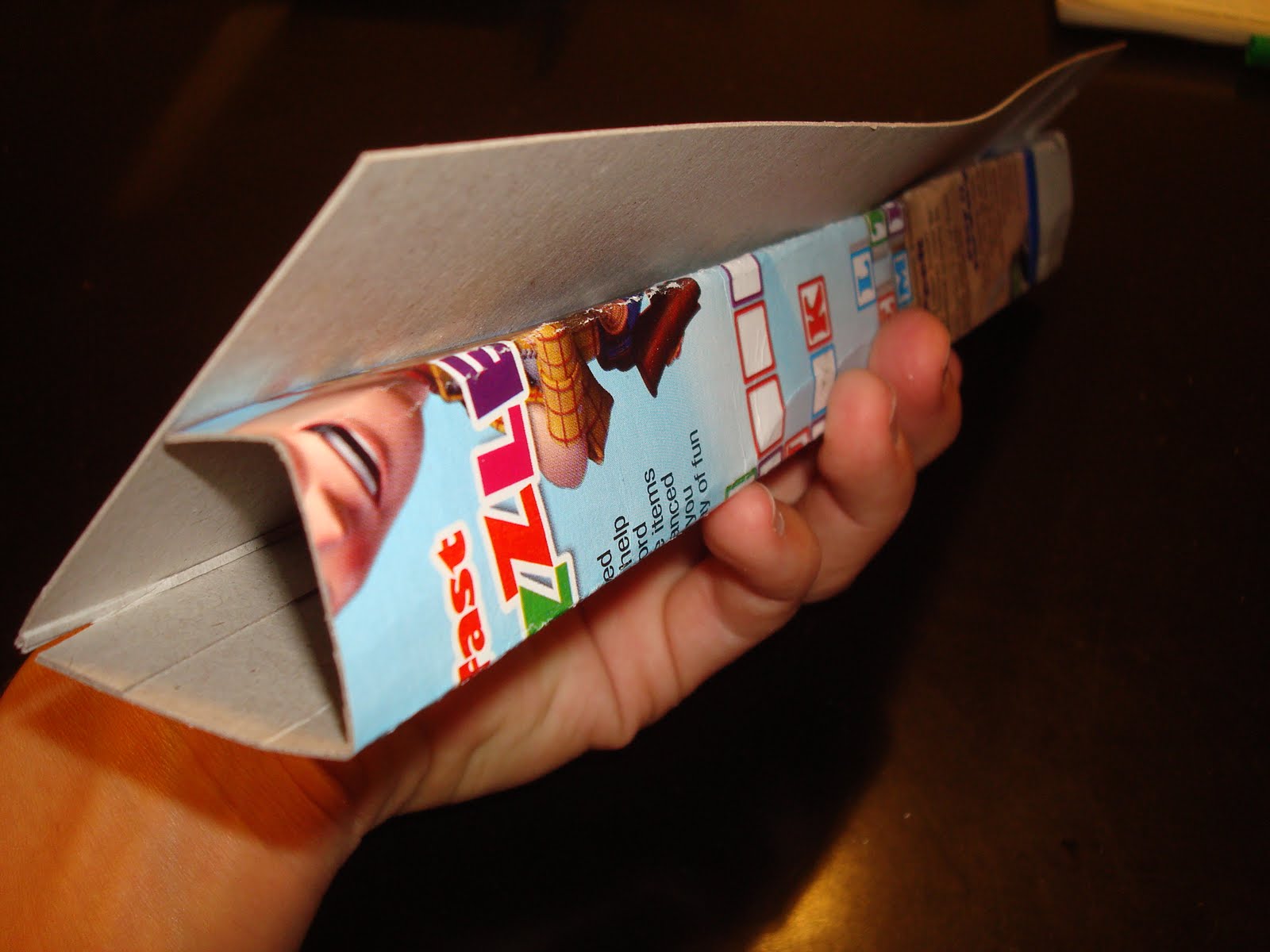
Now you are going to make a 'stand' for each one.
Find part of the cereal box that has a bend in it:

Now you are going to make 2 more folds.
You want to make a triangle, but they are not going to be the same length.
Kind of hard to explain, so here are some pictures:

Once you have creased everything to make a triangle (with a little flap that folds underneath), lay it out flat again. 

Now you will cut individual strips out of it to use for each character:

Take the edge just under the smallest flap and secure it to the character (I used staples):

Now fold it up the way it was and secure the top (I used tape):

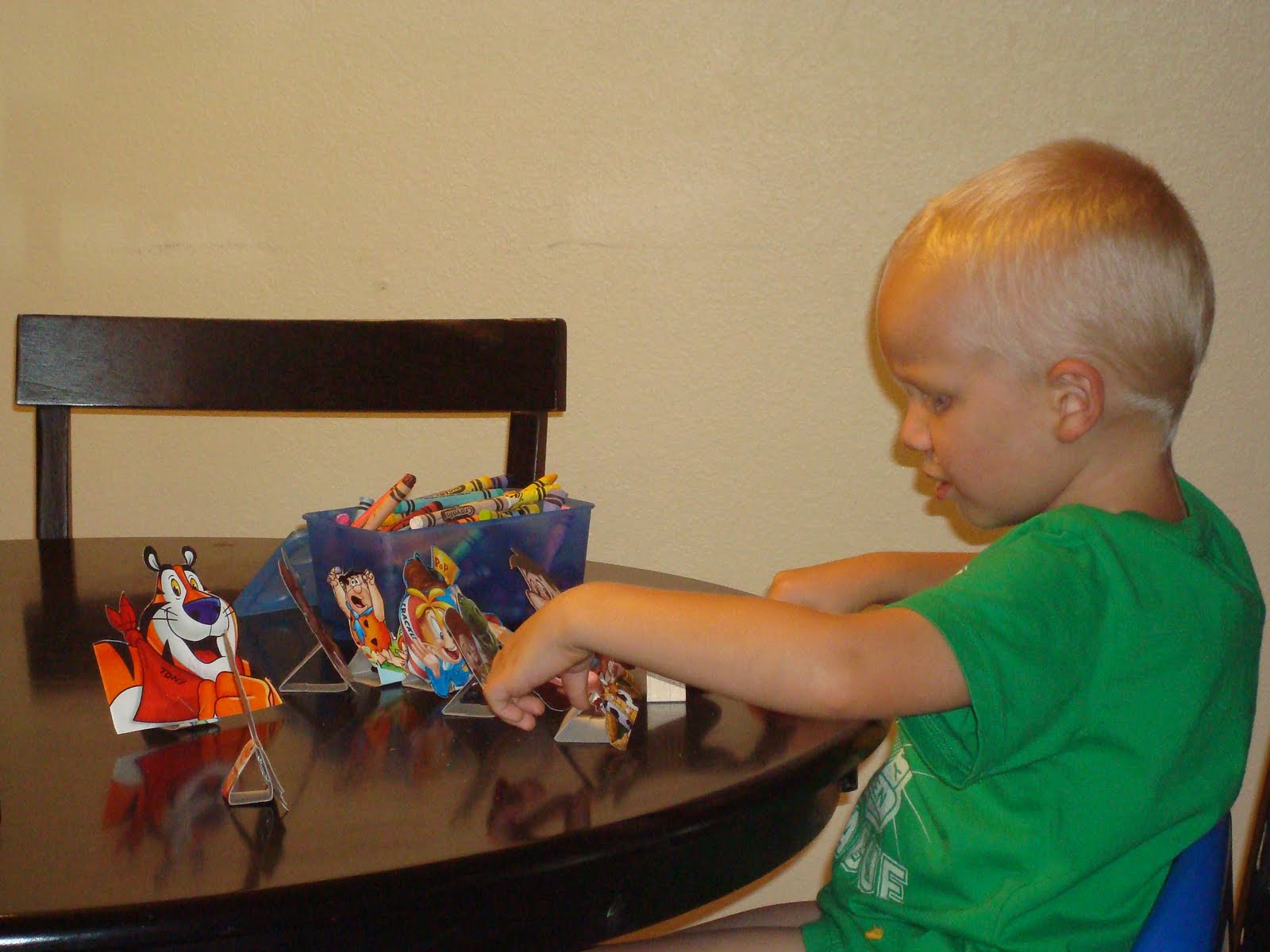
Now they should stand upright:

Now finish the rest:

And try not to be disapointed when all your kid wants to do is color over all of their faces:

Oh well, it kept him involved for long enough.

Enjoy!