Pages

Showing posts with label Child Development. Show all posts

Friday, June 24, 2011

Helping Your Child Attend and Intend to Communicate

This article from Kids on the Move talks about how treating your child like they are a born communicators helps train them to become just that!  It also discusses ways to help children develop these abilities if it doesn't seem to come naturally.  A good read if your child struggles with communication skills.

Helping Your Child Attend and
Intend to Communicate

Do any of the following characteristics describe your child?
- My child doesn't pay attention when I talk to him or try to show him things.

- My child doesn't enjoy playing with toys with me or showing me what she's playing with.

- My child doesn't try to get my attention to notice what he's discovered or what he sees.

- My child won't listen and doesn't seem interested when I try to read a storybook.

- My child's attention span seems short, and she moves quickly from one toy to another as if she doesn't know what to do with them.

These behaviors are all related to joint attention and communicative intent.  Join attention is the ability to share interest in the same object or event with another person.  It includes looking at, pointing to, talking about, or playing with the same objects or events.  Communicative intent is the ability to communicate about these interesting objects or events.  These communications include asking questions, making comments, requesting turns, rejecting objects or turns, and commanding others.  Joint attention and communicative intent both begin to develop during the first days of life.  Poor development in these areas may cause children to have many language and learning problems.

How Do Joint Attention and Communicative Intent Develop?
At birth, infants and their parents spend many hours establishing joint attention.  Their attention is focused on each other.  Parents look into the infant's eyes, and the infant gazes back.  Parents focus attention on the one thing that the child is able to attend to at this age: they attend to the child's body.  Parents encourage the infant to touch, to grasp an adult's finger, and to respond to their voices by talking in a high pitch with exaggerated vocal changes.  The adult's attention on the infant's body helps the infant learn how to share attention.

At the same time, parents treat infants as if they are born communicators.  If the infant hears a noise and widens her eyes, the parent considers that to be a comment about the sound.  The parent answers saying "Did that noise scare you?" or "Yes, your brother dropped the block."  Parents know that the infant was only reacting to the sound, but they behave as if the child communicated something meaningful and intentional.  Every burp, cry, hiccup, or sigh is reacted to as if it were communicating a comment, a request, a protest, or a command.

Three-month-old infants are able to attend to things other than their own bodies.  They begin to look at rattles, stuffed animals, colorful toys, and other interesting things their parents show them.  The joint attention now focuses on these objects.  Parents show and talk about objects, encouraging the child to look at and to try to touch, hold, or explore.  Every smile, hand movement, wiggle, or reach is treated as if it were a sentence requesting, commenting about, asking for, or rejecting the object.  The bond between the parent and the child increases during these mutually enjoyable "conversations."

Because they are treated as intentional communicators from the first day of life, infants become intentional communicators before the first birthday, usually about 10 months of age.  But some children have difficulty establishing these bonds.  They don't seem interested in watching their parents or looking at and talking about the things parents show them.  They show resistance, throw temper tantrums, leave, or attend to something else.  Their attention spans seems very short.  These behaviors are confusing to parents, who may feel hurt, frustrated, and even angry at times.  Parents know that the child isn't learning very much about objects used by people or the language used to talk about them, but their attempts to teach the child don't seem to work.

What Can Be Done?
You can help.  There are strategies you can use if your child has not learned how to attend jointly to objects with you or to communicate intentionally about them.  Play simple games that establish joint attention and communicative intent at the same time.  Follow the suggestions and guidelines outlined here:

- Select interesting toys.  Your child will attend to things that are interesting.  Interesting things are usually colorful and textured, make interesting sounds, or do interesting actions.  Children typically enjoy puppets, stuffed animals, music boxes, wind-up toys, and toys with push buttons and levers.  You will soon discover which things are interesting to your child and which are not.

- Share the toy.  If your child is holding an interesting toy, then there is no reason to include you.  To get joint attention, you must hold the toy and bring it to your child for a turn.  During this turn, the puppet might kiss the child or nibble on fingers and toes.  Or your child might turn the dial or push the button on a toy.  During this turn, you should talk about what your child is doing ("Push the button all the way," "Turn the dial") or about the toy ("The puppet's getting your toes!" "The music sounds pretty").

- Withhold the toy.  The turn should last only a few seconds.  Then hold the toy just out of the child's reach to encourage your child to indicate he wants another turn to play.

- Give and take away.  Bring the toy back to your child for another turn.  Then, after a few seconds, hold the toy at a distance once again and encourage another request for a turn.  You might say things like "Now what?" or "What do you want?"  Continue playing the game through cycles of encouraging the child to communicate, interpreting some behavior as a request for a turn or providing a turn with the toy while you jointly attend to and talk about it, then holding the toy at a distance to set up another cycle.

- Respond to requests.  Indicating the desire for another turn is one type of communicative intent.  During early stages of this play, you may have to respond to a random hand or foot movement or other unintentional behavior.  Treat these behaviors as if they are requests for a turn.  Respond to these random movements just as parents respond to hiccups and burps.  If you behave as if your child is communicating (even when the child isn't), your child will begin to learn how communication works.

- Be patient and continue.  If your child at first resists and fusses, don't give up.  This new way of interacting may seem different and confusing to your child.  Patiently continue to play the game, choosing some behavior to treat as a communicative intent and then jointly attending to your child's play with the toy.

- Recycle.  Your child should start to enjoy the game and should start to do something the keep the game going.  Your child might purposefully hold out a foot if you have been reacting to foot movements.  Or your child might purposely hold out a hand to request a turn with the toy.  As soon as you see these behaviors, provide a turn and continue the cycle.  If your child does not give you a purposeful communication on the next turn, then respond to a random movement again.  Your child is just learning to communicate, and it may take quite awhile to figure out how it works.

- Combine action of toys.  Once your child starts to play the game very successfully, add more complexity.  For example, during the child's turn, put a puppet on the child's hand and then bring over a second toy, such as a cup, a plastic apple, or a hairbrush.  Encourage your child to feed the puppet or brush its hair.  Your child is now learning to attend to objects away from her body.

- Continue cycles.  Continue the cycles: wait for your child to signal a request, present the puppet and other objects for a short turn, and talk about the objects and actions, then hold the toys at a distance to encourage another turn.

- Model language.  Use language yourself that your child can use to request a turn.  Point to the hairbrush and say, "Let me brush his hair" or "Give me the brush."  Model other communicative intents, such as having the puppet protest ("Ouch!  That hurts!"), comment ("My hair is pretty now"), or command ("Brush behind my ears").

- Add steps.  Continue to increase complexity by adding more steps to the play.  During one turn, brush the hair of several puppets, stuffed animals, and dolls, or dry their hair with a towel before brushing it and then looking in a mirror.  Talk about and encourage your child to talk about these events.

- Talk about details.  Begin to focus on parts of objects, talking about the same object or event in detail.  Talk about these details as you point to them.  Talk about the ears or nose of the stuffed animal as they are brushed.  Refer to their length, color, size, shape, spots, smoothness, and so on.  Encourage the child to talk to and about the animals and the ongoing actions.

- Introduce storybooks.  As you look through story-books with your child, talk about the pictures as outlined in the previous step.  If your child has difficulty attending to pictures, demonstrate the depicted actions using similar stuffed animals and objects.  Invite your child to point to parts of the picture, and then talk about what is seen.  Point to parts of the picture, and ask your child to talk about them.

Summary
You can establish joint attention and communicative intent through enjoyable play and storybook reading with your child.  You can also use the same cycles of communication and attention during dressing, eating, and other daily routines.  These interactions teach children how to focus attention and communicate.  Soon children become independent learners who can talk about their world.

Janet A. Norris, Ph.D., CCC-SLP
Copyright 1995 by Communication Skill Builders, a division of The Psychological Corporation / 1-800-866-4446
This page may be reproduced for instructional use. / Catalog No. 3073

Friday, May 20, 2011

Promoting Oral Motor Skills at Home

Another handout from Kids on the Move.
This is great if you suspect your child is having issues with oral motor; it gives you signs to watch out for, and several exercises that you and your child can do together at home to strengthen the muscles in and around the mouth.

Promoting Oral Motor Skills at Home

If your child experiences oral motor difficulties, you may see some or all of the following problems: drooling, poor lip closure, mouth breathing, inability to suck a straw or blow out candles, chewing with mouth open, or the tongue protruding outside of the mouth.  If your child has developed speech, you may be hearing poor articulation of sounds, a nasal quality to the voice, or speech that sounds slushy or slurry.

The oral structures (lips, tongue, jaw, and throat) are made up of many muscles that must work closely together to produce clear, well-articulated speech and safe swallowing.  If weakness or poor muscle coordination exists, the exercises listed below can improve strength and coordination.  Much like exercising to keep our bodies fit, the oral structures can also "work out" to become stronger and more coordinated.

You and your children probably work closely with a speech-language pathologist.  In addition, it is important to continue to practice at home to help your child more quickly learn to control the oral structures and increase muscle strength.

There are two types of exercises you can do with your child.  Active exercises involve your child performing oral movements.  Passive exercises are exercises that you do for or to the child.

Passive exercises work well with infants who are too young to follow directions.  They can be used as warm-up exercises to "wake up" muscles before you begin active exercises.  Also, if your child has been diagnosed as "orally defensive" (very sensitive to touch), these exercises can help to desensitize the child's mouth area to touch and various textures.

Passive Exercises
- Stimulate the outside of the lips, chin, and cheeks with various textures such as cotton swabs, a toothbrush, a small vibrator, a warm or cold cloth, or a cold spoon (do not use ice because it is numbing).  Lightly touch or rub the area to be stimulated.

- Tap firmly on closed lips with two fingers.

- Rub firmly downward on cheeks toward lips and upward from chin to lips.

- Use an index finger and thumb on the corners of the mouth and stretch them outward, then release.

- Stimulate the inside of the cheek and gums with a soft toothbrush or cotton swab, rubbing gently.

- Rub downward firmly on the upper lip and upward firmly on the lower lip.

- Push down firmly on the tongue with a toothbrush or frozen-pop stick several times.  Then tickle the roof of the mouth.  Push down on the tongue several times.

- Alternate placing a small amount of food on the upper lip, the lower lip, and the roof of the mouth; then have the child reach for it and lick it off.  Use foods of different temperatures.  For example, applesauce can be warmed or refrigerated so that the child can "feel" it better.

- Hold an ice cream cone or frozen juice pop just outside the mouth and let the child lick it several times.

Your child may not be able to perform these last two exercises until later in his development.

Other Exercises Specific to Swallowing and Eating
- Rub firmly from the chin down along the throat to encourage swallowing.

- Feed the child with your finger to encourage chewing and biting.

- Place food on alternate sides of the mouth to encourage chewing.

Active Exercises
Children usually develop the ability to do these active exercises between the ages of 18 months and three years.  Use language your child can understand when giving directions to do these exercises.  It is helpful to use a mirror so your child can see the mouth and the way it is supposed to move.  Set a big mirror on the table or use the one in the bathroom so you can be side by side with your child and watch each other making "funny faces."  Do each exercise ten times and all least two to three times per day.  If your child is unable to perform a certain movement, try it once or twice, then move onto the next exercise so as not to discourage your child.  You can use your hand to help guide the tongue or lips into the proper position.  Make these exercises fun for your child, not a frustration.

- Open your mouth as wide as you can, hold for 3 seconds, then close it.

- Pucker your lips like a kiss, and push them forward as far as you can.

- Make a big smile and hold it for 3 seconds.  Then relax.

- Now alternate smile and pucker.

- Purse lips together hard.  Hold for 3 seconds.

- Puff up your cheeks by blowing with your mouth closed.  Hold for 2 - 3 seconds.  Try to make a tight seal so air doesn't escape.

- Stick out your tongue.  Make sure that you push it out in the middle of your mouth, in line with the tip of your nose.

- Try to touch your chin, then your nose, with the tip of your tongue.  (To help guide the tongue, you can use jelly, peanut butter, or other food on the upper and lower lip as a guide to the target.)  Repeat this exercise with the corners of the mouth.

- Lick your lips in a circle.  Start in one directions, then switch and go the other way.

- Put a spoon or tongue depressor against your lips and push hard against it with the tip of your tongue.  Push for 3 seconds, then relax.  Push again.  Relax.

- Drink liquids through a straw to improve lip strength.  (Check with your speech-language pathologist if swallowing problems are also present.)

- Sucking on frozen juice pops or lollipops is good for strengthening.

- Practice whistling.

- Play "blowing games" with feathers, cotton, plastic foam chips, and bubbles.

Summary
The rates at which children show improvement vary widely.  Progress depends on the severity of the problem, the nature of the disorder, and the amount of time you are able to invest in practice.  The key is to be patient and work at a speed that suits your child's needs.  You may even find that your child enjoys doing these exercises and will practice without you!  Remember, exercising can be fun!

Kathryn Morrell, M.A., CCC-SLP
Copyright 1995 by Communication Skill Builders, a division of the Psychological Corporation / 1-800-866-4446
This page may be reproduced for instructional use. / Catalog No. 3073

Thursday, April 14, 2011

Helping Your Child Listen to Learn

Another handout from Kids on the Move:

Helping Your Child Listen to Learn

Why is listening important?
Children learn in many ways.  As infants, they touch, smell, and watch others.  When they are learning to talk, listening becomes even more important.  Understanding what someone says is called auditory comprehension.  As children hear and understand words, they develop their own speech and language skills.

As children approach preschool age, they learn to play together.  Sharing simple conversations and listening to each others ideas become more important as children develop friendships and language.

In school, children need to listen for longer periods of time, tuning out other noises and distractions in the classroom.  In fact, students spend more time listening in school than doing anything else.  If they develop good listening skills, they will have a better chance at succeeding in school.

What can a parent do to help?
Be absolutely sure your child hears normally
Make sure your child's hearing and fluid level in the ears are tested periodically, particularly after a cold or ear infection.  If the doctor suggests ventilation "tubes," have them inserted to prevent further disruption in your child's critical developmental years.

Speak in a way your child can understand.
- Turn down the TV, radio, and other noise sources so your child can hear you without competing noise.
- Get your child's attention before speaking to them.
- Wait until your child is looking at you (gently turn their head if you need to).
- Stand close to your child, squatting at eye level if possible.
- Speak slowly.
- Pause between thoughts.
- Give one direction at a time.
- Give your child time to think after a question.
- Say your message again, another way.

Avoid:
- long explanations or complicated directions
- using "adult-like" idioms (such as, "Try to put yourself in my shoes")

Help your child be an active listener.
Even at an early age, children can learn what helps them listen.  Here are a few suggestions:
Eliminate Distractions: When beginning a conversation or giving instructions, make sure the TV and stereo are off.  If the dishwasher or washer/dryer is nearby and making noise, move to another room.  Explain that you are doing this because it is "time to listen", and you need quiet to do so.  Discuss how hard it is to think about what someone is saying when there are other noises to think about or things to see.

Your child needs to learn to do this independently.  Give feedback and praise when he does so: "What a good idea!  That music from the video game will make it hard for us to listen to each other.  I'm glad you turned it off.  Now we can listen better."

Practice good listening behaviors: When we listen to another person speaking, we make eye contact.  It is also socially polite to stop what we are doing (reading, writing, and other activities) while listening.  Many children with listening difficulties need practice doing this.  And because they may be highly distractible, these behaviors often take their focus away from what is being said.  Social language behaviors are called pragmatic skills  by speech-language pathologists.

Talk about how looking at the person speaking helps keep your eyes away from other things (such as a colorful poster or a squirrel running up a tree).  Discuss how looking at the person who is talking makes that person feel as though what he is saying is important to the listener.

Practice this throughout the week as a family.  It is a good habit for everyone to practice, and it reinforces the concept.

After Eye Contact is practiced successfully, begin to work on the rest of the body.  When a person is listening, the body should be relatively still.  Hands should be relaxed and not tapping pencils, pulling paper clips apart, and so forth.  Feet should be quiet and still.  Practice this as a family as well.  Teach your child to be aware of what her body is and isn't doing when she is listening.

(In some cases, a child with hyperactivity may need to be allowed some non-interfering motion when listening.  Talk to a special education teacher, a psychologist, or a speech-language pathologist for individual suggestions.)

Give feedback.  Encourage your child to ask you to explain words or phrases he doesn't understand: "I don't understand that."  Sometimes children understand short phrases but get confused when they are put together in conversation.  This is called a language-processing or auditory-processing problem.

For children with listening problems, long directions are hard to remember.  Remembering what people say is called auditory memory.  By making listening a successful experience, your child will avoid "tuning out".

Talk together about how hard it is to remember so many things sometimes.  Brainstorm what to do if someone says too many things at one time.  Encourage your child to say, "I can't remember all that.  Can you tell me one thing at a time?"

Give positive praise whenever your child lets you know that she has forgotten something you've said or is trying to understand it: "I'm glad you told me this.  This time I'll tell you one thing at a time.  Are you ready?"

Use strategies to help remember.  What if your spouse wanted you to pick up four items from the supermarket?  Most of us reach for a pen, because writing the items down ensures that we will be able to follow through on the request later.  Because children are even less able to remember multiple items or directions, they too can benefit from learning to write things down.  But what if they don't know how to write yet?

- You can help your child learn to draw a simple sequence of pictures to remember the steps.  For example, suppose the directions are to "go upstairs, brush your teeth, wash your face, and put your pajamas on."  Together, you can brainstorm how to draw several pictures to remind your child what to do.  Listening and putting pictures in order is also a good way to prepare for taking notes in later school years.

- Help your child make a mental picture of what is being described (sometimes closing our eyes helps us block out distractions.)  Describe a scene, such as a farm: "I saw a farm with a white, wooden fence around the pigs.  Some of the pigs were rolling in mud.  Nearby a farmer was feeding some chickens."  Have your child draw a picture of the farm on paper.  Talk about what we "see" in our minds.

- Help your child learn to listen for "important" information during story time.  Ask simple who, what, where, or when questions, then read the next sentence or two from the story.  See if your child can remember the answers.

Patricia McAleer Hamaguchi, M.A., CCC-SLP
Copyright 1995 by Communication Skill Builders, a division of the Psychological Corporation / 1-800-866-4446
This page may be reproduced for instructional use. / Catalog No. 3073

Thursday, March 31, 2011

Sign Language

Sign Language is the perfect way to help the communication process along with your children.
Many kids are able to sign long before they can speak!

This post will cover tips on using sign language with your children, instructions on how to sign some early and everyday signs, and my recommended home video's.

Tips on Using Sign Language
Keep these tips in mind as you and your child begin using signs.

Use signs that are useful for your child and a part of his life.
If the signs aren't useful, your child won't learn them or use them.

Be sure that you have your child's attention when you sign to him or show him signs.

Use the sign and word(s) together.
Repeat words verbally after your child signs them to reinforce the spoken word.

Use the signs that your child is learning in as many situations as possible.
Your child needs to see a sign many times and understand them before he will try to sign them.

Accept your child's signing attempts and try not to over-correct.
As your child begins to use signs, he may have difficulty making the sign because he can't form his hands in the shape of the sign.

Try not to anticipate your child's needs before he does.
Leave enough time for your child to recognize and express his need to communicate.

Start teaching as early as 6 months.
You can start signing when your baby is between 6 and 8 months and holds your gaze for a few seconds.

How to Sign Early and Everyday Signs

Milk: Hold your hand out in front of you - open and close in a squeezing motion (like milking a cow).


Eat/Food: close your fingers to your thumb and tap fingertips against your lips

More: close your fingers to your thumb (on both hands) and tap fingertips together.


Drink: Position hand like it is holding a cup, and "take a drink"

Finished / All Done: Hands out with palms facing you - then turn them over so palms face away
Please: Palm rubs on chest in circle

Thank You

Thank You / Your Welcome: Move open hand from your chin, going down


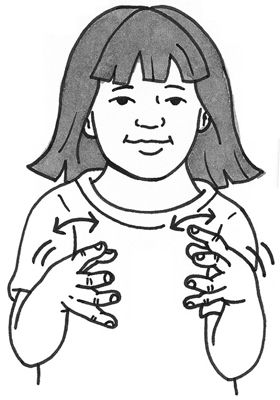
Play: Both hands with thumb and pinkie outstretched, and shake

Ball
Ball: Claw hands to form a ball shape.  Rotate hands alternately.

Stop: One hand moves down and is stopped by the other hand (palm up)

Help: Thumbs up on top of one hand, and move them both up
Mom: Outstretched hand, thumb taps your chin
Dad: Outstretched hand, thumb taps your forehead

Signing Time
If you are unfamiliar with the Signing Time Series, it is definitely worth checking out (see the links to Amazon on the right hand side bar as well).
They are 30 minute dvd's that teach children how to sign.
My boys LOVE them, and they were an absolute life saver with Cannon - if they impact Lincoln half as much as they did him I will be a happy mama.

Thursday, March 3, 2011

Sensory Activites and Ideas

This is another handout that follows up with what I posted about last week (Tactile, Vestibular and Proprioceptive Sensory Integration).
It is basically a list of activities that are good for causing awareness to the 3 senses listed above (a lot of them are just great ideas for kids activities in general!)

Sensory Activities and Ideas

Tactile (touch):
- Texture bucket: fill it full of rice, beans, cheerios, uncooked pasta, beads, cream of wheat, sand.  Very similar to the Bean Box idea.

- Touching a variety of textures, such as: pieces of carpet, soft cloth, sand paper, scouring pad, sponge, koosh toys, bean bags, paint brush, feather duster, turkey baster,finger puppets, stress ball, Gak, sand, rice, beans, egg-crate mattress, fake fur, foam pieces, grass, sand/dirt, corduroy, cotton, wool.

- Massage: hands, arms, feet, and cheeks as tolerated.

- Water play: indoors or outdoors.

- Lotion: rubbing lotion (scented) on arms, hands and feet.

- Finger paint: use pudding, Jell-O, whip cream, shaving cream, warm and cold pudding, etc.

- Gluing textures as part of a craft project: glue rice, beans, fabrics, sand, macaroni, etc.

- Hidden Objects: hide toy in foam beans, rice, Easter grass, etc. and have the child dig around and look for it.

- Playdough/theraputty: roll putty into snakes, garlic press, cookie cutters, squeeze, pull apart to find hidden objects.

- Cooking with various ingredients and mixing the foods.

- Popping Bubbles

Vestibular (movement):
-  Therapy Ball Activities: bouncing with as much support as needed, rocking in prone and supine; always do it on top of a mat for safety.

- Rocking Board: Sitting, prone and supine.

- General Playground Activities: climbing, swinging, sliding, crawling, etc.

- Swinging: use a variety of swings and positions to vary the stimulation.

- Rolling down a hill or incline.

- Rolling on the mat or floor.

- Blanket Swinging, or being pulled on a blanket.

- Scooterboard activities: either pushing/pulling the resident or doing it themselves.

- Rocking on lap or in a rocking chair.

- Bouncing on lap.

- Slides: for residents with enough strength and sitting balance. 

- Swimming

- Riding in a stroller or wagon
- Bouncing/jumping on a trampoline or mattress

- Sit n' Spin

- Riding a bicycle/trike
Proprioceptive (deep pressure):
- Brushing and Joint compression program (trained by OT or OTA).
- Deep pressure massage to various body parts.

- Scooterboard Activities: either pushing/pulling the resident or doing it themselves.

- Weighted vest or blanket (to be worn no longer than 20 minutes at a time).

- Wrist or ankle weights for body awareness.

- Steamroller games with bolster.

- Pushing/pulling heavy objects, such as wagons, carts, boxes, furniture

- Wheelbarrow walk

- Trampoline: jumping or being gently bounced.
- Kicking a medium-sized ball.

- Beanbag games (catching / throwing).

- Squeezing sponges in water.

- Squeezing playdough

- Bean bag chair

- A safe haven (small tent with pillows) to self-calm.
- Arm wrestling

- Bike or Tricycle riding
Visual:
Always darken the room when working with a lighted activity to increase the contrast.  Avoid rapid, flashing lights and strobe lights as they can induce seizures.

- Light Box Activities: use different colors, shapes, patterns, etc.

- Suspend a ball over child's head while lying on back.  Child follows lateral, vertical, diagonal, and circular movements of the ball.

- Flashlight - move flashlight around a darkened room.  Have children follow it by pointing or stepping on it.  Place a colored cloth over the flashlight for variation.

- Glittery and shiny objects / toys.

- Mirror Games: have the child look at themselves and other objects in the mirror.

- Encourage playing with puzzles, mazes, dot-to-dot pictures, hidden-picture games, and picture books, one page at a time.

Auditory:
- Reading stories out-loud to the residents (great group activity)
- Cordless Headphones for group auditory stimulation / activities.

- Playing copy-cat: try to get the residents to imitate sounds you make; copy their noises first to get it started.

- Soft Music and Nature Sounds (cd's)

- Upbeat, fast music.  Find music that each resident enjoys.

Smells:
Always describe and talk about the scents as they are presented.

- Scent bottles: present just 2-3 different smells over one session to avoid over-stimulation.

- Scented markers

- Cooking Activities, discussing smells of foods at mealtime.

Compiled by Paul Daybell, OTR 

Thursday, February 24, 2011

Sensory Integration

This handout was VERY interesting to me.  It touches on points that I had never thought of, like how we all have 2 other senses in addition to the 5 we normally talk about; vision, hearing, taste, smell and touch.

Sensory Integration

What is sensory integration?
- Sensory Integration: the neurological process that organizes sensation from one's own body and from the environment and makes it possible to use the body effectively within the environment (Ayres, 1988).  We constantly receive input through our various senses, our brain then registers and interprets the input and we then act accordingly.

- Sensory Processing: the process of the brain receiving, interpreting and organizing input from all of the active senses at any given moment.

What sensory systems do we use everyday, all the time?
- The "usual" 5 senses, which are: vision, hearing, taste, smell and touch (tactile)

- The 2 other less-known senses: Vestibular (movement) and Proprioception (deep pressure)

- All of the different senses can have difficulties; however, the majority of "sensory integration" problems come from the Tactile, Proprioceptive and Vestibular senses.

- Tactile: the sensation of touch, allows people to manipulate objects in a refined manner, feel input throughout our body through receptors in the skin.

- Vestibular: is basically the "equilibrium" system that allows people to detect movement and is comprised of 3 semi-circular canals which detect and register movement and gravity receptors (utricle/sacule).

- Proprioception: this is usually subconscious information the brain receives from our muscles and joints.  This information tells us where our body parts are in space.  It allows us to walk, run, jump and generally move in a coordinated manner.

What happens when there are problems in these areas?
- With each of these senses, there is "normal" range of functioning.  Problems occur when people interpret the information they receive through their senses either too highly (hypersensitive) or too lowly (hyposensitive).

- Hypersensitive or over reactive systems: the individual's body and/or brain interprets incoming sensory stimulation as overwhelming or way too much and they become resistive or defensive to this input.

- Hyposensitive or under reactive systems: the individual's body and/or brain interprets incoming sensory stimulation as under arousing or way too little and they don't register it or feel it.

Typical sensory integration difficulties:
- Tactile: when there is a problem, usually people are hypersensitive to the feeling of being touched or certain textures touching their skin.  Many times, people are more sensitive on their hands, feet and around and in their mouth (orally-defensive).

- Vestibular: with movement, problems can arise on both extremes.
          1. Hypersensitive: intolerance to movement or a fear of falling/heights (gravitational insecurity).  This can lead to becoming resistive and defensive to movement activities and having their feet off of the ground.  They may become physically sick/nauseated with normal amounts of movement.
          2. Hyposensitive: the brain fails to register the movement appropriately; therefore, the individual will then seek additional movement by initiating excessive movement, such as rocking, spinning, swinging, etc.  The individual may also have difficulty with postural responses, balance and bilateral coordination.

- Proprioceptive: The brain has difficulty registering the deep pressure input appropriately (hyposensitive); therefore, these individuals seek additional deep pressure by bouncing, jumping, rocking hard in a chair, "crashing" into objects, seeking tight spots in which to squeeze themselves, etc.  Treatment includes setting up a variety of deep pressure activities (sensory diet) that fulfill this need in an appropriate way and hopefully decrease the "seeking" behavior.

- Children can be hyper or hypo-sensitive to visual, auditory, tastes, smells also.  These are more obvious by the behavior they exhibit, either seeking or avoiding the specific sensory stimulation.

- Dyspraxia or "motor planning": difficulty with the ability to conceive, organize and execute a sequence of actions that are new and unfamiliar.  The ability to execute a new motor action is accomplished through the coordination of the tactile, vestibular and proprioceptive senses.  Individuals with dyspraxia are often clumsy and uncoordinated.

Treatment:
- To provide sensory stimulation in an active, controlled and safe manner to allow the person to learn to experience these sensations with success.  The individual must first trust the situation and actively participate in the activity and then gradually work through a variety of sensory experiences and increase their tolerance to the activity and sensory input.

- Find out what the individual tolerates and does not tolerate in each sensory area and then set up a plan to work on those items/activities tolerated first and then gradually vary the input.  Go slowly and make sure the person is comfortable before taking the next step.

- Many individuals with physical disabilities are unable to move and experience various sensations.  Therefore, often they enjoy being assisted in experiencing vestibular (movement), proprioceptive (deep pressure), tactile and other sensory input.

- For those children that seek or crave sensory input, give it to them as part of their "sensory diet" in a hope that it will decrease the inappropriate "seeking" behavior.  This is a good time to work on more appropriate social interaction, eye contact, requesting and vocalizations.

Compiled by Paul Daybell, OTR


Next week I will post an article on Sensory Activities and Ideas.

Thursday, November 4, 2010

Motor Development

This is yet another handout I recieved from Kids on the Move.
It specifies the development of motor; what comes first, how old the average child should be doing what, etc.
I like checklists such as these so parents can determine where their child is, but more importantly what they can focus on to help further their development.

Motor Development
First Steps and Beyond

Standing Balance
Child will:
- Spend a lot of time standing and playing at a chest high surface
- Stand with back support (against a couch)
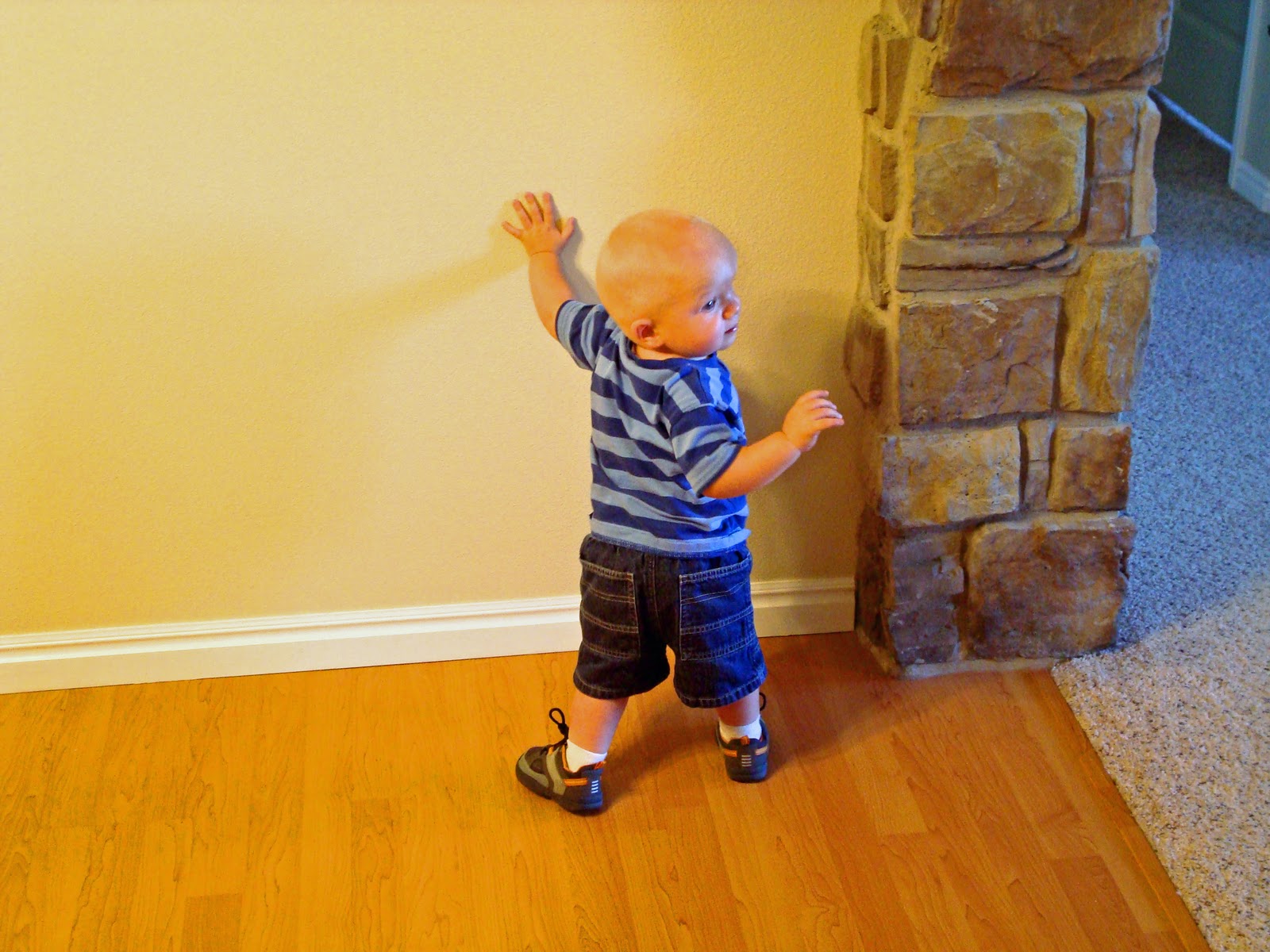
- Stand facing a flat surface (fridge, wall or cabinet) so trunk is not supported.
- Stand in the middle of the room holding onto a common toy.

Cruising (9-13 months)
Child will:
- cruise at different surfaces - starting with chest high

Encourage cruising by:
- moving a toy farther away, forcing them to move to it
- shift weight at their hips to encourage leg movement
- remember to help child to cruise in both directions

Cruising Gaps
Ecourage by:
- starting with furniture together or very close to build confidence
- increase gaps as able
- set up cruising opportunities if there aren't any already (use a kitchen chair, ottoman, etc).

Walking with Support (10-12 months)
- Once child can balance, hold hands at child's side (no higher than chest).

Encourage by:
- Progressing to one handed support by having child hold a toy (for a short distance).
- Push a push toy, weight it down if needed.
- Push a chair, laundry basket or box
- Walk with an object you hold (like a hoop)

Walking Unsupported (11-13 months) 
Child will:
- walk to a parent or couch and let go for the last 1-2 steps
- stand with back against the couch and then try to step forward from there
- may do better with or without shoes

Early Walking Tips (13-15 months)
 - walk on different surfaces (tile, carpet, grass, cement, sand, mattress)
- walk between surfaces; if indoor use blankets, pillows, cushions, etc.
- walk wearing big shoes

Early Walking
 - walk up or down small inclines or curbs
- carry light toys or pull toys on a string

Standing from the Ground Without Support (12-15 months)
 Child will:
- get onto hands and feet and push up into standing
- more mature pattern is to go into a half kneel and push from the floor to stand

Encourage by:
- putting their hands on a slightly higher surface like a cushion, box or bench

Backwards and Sideways Walking (14-15 months)
Encourage by:
- playing "Ring around the Rosie" to walk sideways
- pull a toy on a string to walk backwards
- walk backwards away from getting tickled
- rearrange furniture so that you have to walk sideways to get through
- you push a box while child pulls and walks backwards

Rapid Walking/Running (14-18 months)
Encourage by:
- holding childs hand and pulling him to encourage a faster walk
- play chase
- "run" down a small incline (this encourages a rapid walk)

Walking Upstairs With One Hand Held (17-19 months)
 Encourage by:
- trying to step up onto a small curb, box or stool
- showing them how to hold onto a rail or wall
- not always holding the same side

Alternating feet is not important at this stage.
Kids may lead with the opposite leg of the hand you are holding onto.

Walking Upstairs Alone (24-25 months) and Alternating Feet (30-34 months)
Encourage by:
- starting with a curb or small step stool to practice stepping up unsupported and build strength
- to alternate feet start with physical support and a lot of verbal cues
- put red and green stickers on each foot and match them to red and green cut outs you put on the stairs
Walking Downstairs with a Rail (24-26 months) and Alone (25-27 months)
Encourage by:
- starting with a curb, a few stairs or a child size stair case
- you can stand in front and hold one or both hands, remember not to show a worried face
- place childs hand on the wall so that they use it for support

Kicking a Ball (18-24 months)
- start with a large lightweight ball like a beach ball
- start by walking into a ball and then encourage kicking when standing still
- remember to use both feet

Running "Fairly Well" (18-24 months)
- arms should swing in alternate pattern with legs
- both feet are leaving the ground
- pull holding onto a hand to encourage a faster pace or chase

Climbing Onto an Adult Chair (18-21 months)
- a couch is the easiest, then a chair with arms, then a kitchen chair
- you can start by stepping onto a slightly higher surface like a bench or box or taking a cushion off
- help them raise one leg up, then hold it there

 Picking Up a Toy from the Floor (19-24 months)
 - start with picking up a toy from a slightly higher surface (cushion, bench, box or your hand)
- make sure the child is bending his knees to sqaut

Jumping in Place (22-30 months)
Encourage by:
- bouncing to music and encourage knee bending
- jumping on a trampoline, a mattress while holding onto the headboard, the crib holding onto a rail, or the sofa holding onto the back
- wait for child to initiate the jump and then help so that feet leave the ground

Jumping
 - jump to pop bubbles, bubble wrap, or jump into or out of a hoop
- jump off of a small step, curb or box; hold hands and help both feet leave the ground if the child is stepping down
- watch "tigger" videos, sing jumping songs

Standing on Tiptoes (23-25 months) and Walking on Tiptoes (25-30 months)
Child will:
- reach up for a toy on the counter, a picture on a wall or a ball you are holding

Encourage by:
- holding hands and pulling up to encourage getting onto tiptoes
- pretend games - tiptoe past the sleeping dolls, pretend to "grow"

Walking with More Mature Gait (23-30 months)
- walk between lines that are drawn or taped on the ground (they should get as narrow as 8" apart)
- walk on a plank of wood
- walk along a long piece of toilet paper

Catching a Ball (24-26 months)
- blow bubbles and have child try and "catch" or pop those that are blown towards them (start in sitting position so balance is not an issue)
- encourage child to trap ball against body
- catch a large balloon, light beah ball or gurdy ball
- start closely placing the ball in childs hand and then move further back

Running with Control (24-30 months)
- play chase around a large obstacle in the room (chair, trash can or a tree outside)
- gradually decrease the size of the obstacle to the size of a book, increase the number of obstacles
- play "red light, green light" to stop quickly

Balancing on One Foot Briefly (24-30 months) and for 5 Seconds (30-36 months)
- stomp on bubbles or bubble wrap
- stand to put on an adult's shoe without assistance or while getting dressed
- play "Simon Says"
- kick a ball
- walk up stairs with support
- put a ladder on the floor and step over the rungs
- try to lift up a bean bag that is placed on the foot

Riding a Tricycle (32-36 months)
- find a trike that allows the child's feet to reach the pedals and has a long lever arm
- strap in feet if they do not stay on the pedals
- push the trike with feet on the pedals so that child feels how the pedals move, start on a small incline

General Motor Planning
- encourage playing in new ways so that the child has to problem solve to do the task (go to a park)
- climb over small obstacles (like the ledge into the ball pit) or onto something unstable (platform swing)
- use play equipment for combining activities like crawling in tunnels, climbing, sliding and jumping

Red Flags - When to Consult with a Physical Therapist
- neglect of one side of the body - strong favoring of one arm or leg or leading with one leg
- not pulling to stand by 11 months or walking by 17 months
- can't stand without furniture 1-2 months after walking
- up on toes more than 50% of the time
- severe in-toeing or out-toeing that doesn't correct with time
- severely "flat" feet (pronated)
- clumsiness is so severe that it effects function

Thursday, September 2, 2010

How You Talk with your Child is Important

I went to a speech and language class and learned some interesting facts.
Naturally I failed to write down the source, so I guess you'll just have to take my word for it.

A study was being conducted among children concerning speech and language.
They found that some kids were significantly more advanced than others.
After surveying the parents, they found that the majority of advanced children had parents that followed these
basic speaking/questioning patterns:

Basically the ways parents represented things to their children were categorized into 3 groups: Yes/No quesitons, Modeling words, and "Wh" questions.

- Yes/No Questions: only requires child to say either a'yes" or "no"

- Modeling words: this involves everyday things, like your child pointing to a sippy cup and you saying "you want juice?"  In a nut shell it involves all commenting and naming.

- "Wh" questions: asks 'who', 'what', 'when' 'where'.  'Why' is usually not included for this particular exercise.

These 3 categories are naturally a part of every parents' speaking pattern.  The study showed however, that the advanced children had parents who used certain tactics more than others.
From that study, percentages were calculated to determine how much of each category should be used in daily life to help increase your child's speech and language abilities:

- Yes/No Questions: 10%
- Modeling Words: 50%
- "Wh" Questions: 40%

Modeling words makes up half because this teaches children how to label, express and understand the world around them.  It also provides them with correct speaking habits.  Not to mention the fact that it is what you are always doing, whether you are talking to your child or not.
The biggest difference in the study was the number of parents who tried to steer clear of Yes/No questions.  These questions severely limit your child's ability to express himself or his vocabulary, as well as the mental capacity it takes to answer "wh" questions.
Not to say that there is never a time for yes/no questions, but the researches recommended trying to turn those into "wh" questions instead.
For example: Instead of saying "It's time for bed.  Would you like me to take you?"  You could say "It's time for bed.  How do you want to get there?"
This helps your child by allowing him more opportunities to speak, forces him to use a bigger vocabulary, and of course express himself more completely than a simple yes or no could.

I though that was a pretty simple way to implement big changes in your children's speech and language abilities.
If you want more specific ways to help improve your interaction, here is another handout I recieved...

How you Talk with your Child is Important
by Diann D.Grimm, M.A., C.C.C., Ed.S.

You can use everyday routines and events to help your child learn language.  Chldren learn words and the rules for using them by listening to others talk.  Then they imitate the language they have heard.  Your child is using you as a "model" for correct language.  Therefore, what you say - and how you say it - is an important influence on your child!

Talk about the here and now
It helps children understand when you talk about objects, people, and events that can be seen, heard, and touched.  So talk about events as they happen.  Say "I put the ball in the box" while doing the action.  Name objects that the child can see.  "A doggie!  Look at the doggie!"  Talk about people around you.  "There's a police officer.  She helps us."

Talk about what is important to your child
Help your child learn to listen by talking about things that interest the child.  If your child is playing with blocks on the floor, it's a good time to say, "Those are big blocks.  This one is red."

Remember that what is interesting to your child may not be interesting to you.  Children are experimenting and learning about the world.  Common objects such as pots and pans, boxes, and rocks can be interesting to them.

Talk out loud about what you are doing
Any time you are with your child is a time for language learning.  By putting your thoughts and actions into words, you are teaching your child language.  Use simple phrases and sentences to describe what you are doing, seeing, and thinking.  For example, while making a cake: "I'm putting in the eggs.  Now I'm mixing the batter.  Going around and around.  It needs more flour.  I'll put in a little more."

At times, talk for your child
Your child is able to think before being able to express those thoughts.  You can help by sometimes putting thoughts into words for your child.  By doing this, you give your child words and sentences to remember for future use.  You may need to guess what your chid is thinking at the moment.  If your child is playing, you might say: "That's a big car.  Make it go.  It goes so fast.  There's a little car.  It can go too."

It helps to talk about what your child is doing or seeing.  It is also important to put your child's feelings into words.  Your child experiences a wide range of emotions daily.  The child may not have words to express these feelings. You can help your child understand emotions by labeling them. For example: "I can see that you are angry.  Tommy broke your tape recorder.  But now we can fix it."

Expand your child's remarks
Child: "Juice."
Parent: "You want juice."
Child: "Doggie run."
Parent: "The doggie runs fast."
This strategy is called "expansion."  In using expansion, the parent above did not change the child's meaning.  The parent merely made the child's remark slightly longer.  As a result, the child heard a good language model.  In addition, the parent did not "correct" the child's remark or require the child to repeat the expanded remark.  The use of expansion is s non-threatening way to model good language for your child.

Add a little more information to your child's remark
In addition to expanding your child's remark, you can build on what your child has already said by adding new information.  Your remark can include your child's original thought plus a new idea.  Use simple sentences to add new information.  For example:
Child: "Truck there."
Parent: "Yes, there's a big red truck."
Child: "Doggie bark."
Parent: "The doggie is barking.  He likes to bark and make noise."

Don't ask your child to repeat what you say
You only need to provide good language models.  Your child will learn without repeating, and without your "correcting" mistakes.  Gradually, your child will learn to say things the way you do - without pressure and at the child's own pace.

Praise your child's language attempts
Keep talking.  And keep learning fun!

Vocabulary
Expand - Build upon what your child said.  Add a few words to make a complete sentence or correct expression.  Expansion gives your child a model of correct speech.  It also shows your child that you have understood the child's remark.

Model - To provide an example of good speech or other behavior; to demonstrate a desired verbal response.

Refer to: 5.0 Articles on Home Activites for Speech and Language Development

Thursday, August 12, 2010

Key Social, Emotional, and Communication Milestones

This is another handout I received from Kids on the Move.
Is Your Baby Meeting These Important Milestones?
Key Social, Emotional, and Communication Milestones for Your Baby's Healthy Development
By
Stanley I. Greenspan, M.D.
Barry M. Prizant, Ph.D., CCC-SLP
Amy Wetherby, Ph.D., CCC-SLP

The milestones in this chart are important to a child's healthy learning, behavior, and development.  While each child develops differently, some differences may indicate a slight delay and others may be a cause for greater concern.  The following milestones provide important guidelines for tracking healthy development from four months to three years of age.  These milestones should not be used in place of a screening, but should be used as discussion points between parents and physicians at each well visit.  If a child does not have the skills listed - or if there is a loss of any skill at any age - be sure to let your physician know.

Does your Baby...
At 4 months:

  • Follow and react to bright colors, movement, and objects?

  • Turn toward sounds?

  • Show interest in watching people's faces?

  • Smile back when you smile?
At 6 months:

  • Relate to you with real joy?

  • Smile often while playing with you?

  • Coo or babble when happy?

  • Cry when unhappy?
At 9 months:

  • Smile and laugh while looking at you?

  • Exchange back-and-forth smiles, loving faces, and other expressions with you?

  • Exchange back-and-forth sounds with you?

  • Exchange back-and-forth gestrues with you, such as giving, taking, and reaching?
At 12 months:

  • Use a few gestures, one after another, to get needs mets; like giving, showing, reaching, waving, and pointing?

  • Play peek-a-boo, patty cake, or other social games?

  • Make sounds, like "ma," "ba," "na," "da," and "ga?"

  • Turn to the person speaking when his/her name is called?
At 15 months:

  • Exchange with you many back-and-forth smiles, sounds, and gestures in a row?

  • Use pointing or other "showing" gestures to draw attention to something of interest?

  • Use different sounds to get needs met and draw attention to something of interest?

  • Use and understand at least three words, such as "mama," "dada," "bottle," or bye-bye?
At 18 months:

  • Use a lot of gestures with words to get needs met, like pointing or taking you by the hand and saying, "want juice"?

  • Use at least four different consonants in babbling or words, such as m, n, p, b, t, and d?

  • Use and understnad at least 10 words?

  • Show that he or she knows the names of familiar people or body parts by pointing to or looking at them when they are named?

  • Do simple pretend play, like feeding a doll or stuffed animal, and attracting your attention by looking up at you?
At 24 months:

  • Do pretend play with you with more than one action, like feeding the doll and then putting the doll to sleep?

  • Use and understand at least 50 words?

  • Use at least two words together (without imitating or repeating) and in a way that makes sense, like "want juice"?

  • Enjoy being next to children of the same age and show interest in playing with them, perhaps giving a toy to another child?

  • Look for familiar objects out of sight when asked?
At 36 months:

  • Enjoy pretending to play different characters with you or talking for dolls or action figures?

  • Enjoy playing with children of the same age, perhaps showing and telling another child about a favorite toy?

  • Use thoughts and actions together in speech and in play in a way that makes sense, like "sleepy, go take nap" and "baby hungry, feed bottle"?

  • Answer "what," "where," and "who" questions easily?

  • Talk about interests and feelings about the past and the future?
Red Flags
If your baby shows any of these signs, please ask your pediatrician or family practitioner for an immediate evaluation:

  • No big smiles or other warm, joyful expressions by six months or thereafter (1)

  • No back-and-forth sharing of sounds, smiles, or other facial expressins by nine months or thereafter (1)

  • No babbling by 12 months (2)

  • No back-and-forth gestures, such as pointing, showing, reaching, or waving by 12 months (2)

  • No words by 16 months (2)

  • No two-word meaningful phrases (without imitating or repeating) by 24 months (2)

  • ANY loss of speech or babbling or social skills at ANY age (2)
(1) Greenspan, S.I. (1999) Building Healthy Minds, Perseus Books
(2) Filipek, P.A., et al. Practice parameter: Screening and diagnosis of autism, Neurology 2000, 55: 468-79.

The key social, emotional, and communication milestones were compiled and adapted with permission from the following sources: Greenspan, S.I. (1999) Building Healthy Minds, Perseus Books; Prizzant, B. M., Wetherby, A.M., Roberts, J.E. (2000) Communication Disorders in Infants and Toddlers, In C. Zeanah (Ed.) Handbook of Infant Mental Health, Second Edition, New York: Guilford Press; and Wetherby, A.M. (1999) Babies Learn to Talk at an Amazing Rate, FIRST WORDS Project, Florida State University.

The authors wish to thank the following people who contributed to these milestones: Ilene Beal; Frances P. Glascoe, Ph.D.; Rebecca Landa, Ph.D.; and Robert H. Wharton, M.D.

2001 First Signs, Inc. All rights reserved.