Pages

Thursday, March 3, 2011

Sensory Activites and Ideas

This is another handout that follows up with what I posted about last week (Tactile, Vestibular and Proprioceptive Sensory Integration).
It is basically a list of activities that are good for causing awareness to the 3 senses listed above (a lot of them are just great ideas for kids activities in general!)

Sensory Activities and Ideas

Tactile (touch):
- Texture bucket: fill it full of rice, beans, cheerios, uncooked pasta, beads, cream of wheat, sand.  Very similar to the Bean Box idea.

- Touching a variety of textures, such as: pieces of carpet, soft cloth, sand paper, scouring pad, sponge, koosh toys, bean bags, paint brush, feather duster, turkey baster,finger puppets, stress ball, Gak, sand, rice, beans, egg-crate mattress, fake fur, foam pieces, grass, sand/dirt, corduroy, cotton, wool.

- Massage: hands, arms, feet, and cheeks as tolerated.

- Water play: indoors or outdoors.

- Lotion: rubbing lotion (scented) on arms, hands and feet.

- Finger paint: use pudding, Jell-O, whip cream, shaving cream, warm and cold pudding, etc.

- Gluing textures as part of a craft project: glue rice, beans, fabrics, sand, macaroni, etc.

- Hidden Objects: hide toy in foam beans, rice, Easter grass, etc. and have the child dig around and look for it.

- Playdough/theraputty: roll putty into snakes, garlic press, cookie cutters, squeeze, pull apart to find hidden objects.

- Cooking with various ingredients and mixing the foods.

- Popping Bubbles

Vestibular (movement):
-  Therapy Ball Activities: bouncing with as much support as needed, rocking in prone and supine; always do it on top of a mat for safety.

- Rocking Board: Sitting, prone and supine.

- General Playground Activities: climbing, swinging, sliding, crawling, etc.

- Swinging: use a variety of swings and positions to vary the stimulation.

- Rolling down a hill or incline.

- Rolling on the mat or floor.

- Blanket Swinging, or being pulled on a blanket.

- Scooterboard activities: either pushing/pulling the resident or doing it themselves.

- Rocking on lap or in a rocking chair.

- Bouncing on lap.

- Slides: for residents with enough strength and sitting balance

- Swimming

- Riding in a stroller or wagon
- Bouncing/jumping on a trampoline or mattress

- Sit n' Spin

- Riding a bicycle/trike
Proprioceptive (deep pressure):
- Brushing and Joint compression program (trained by OT or OTA).
- Deep pressure massage to various body parts.

- Scooterboard Activities: either pushing/pulling the resident or doing it themselves.

- Weighted vest or blanket (to be worn no longer than 20 minutes at a time).

- Wrist or ankle weights for body awareness.

- Steamroller games with bolster.

- Pushing/pulling heavy objects, such as wagons, carts, boxes, furniture

- Wheelbarrow walk

- Trampoline: jumping or being gently bounced.
- Kicking a medium-sized ball.

- Beanbag games (catching / throwing).

- Squeezing sponges in water.

- Squeezing playdough

- Bean bag chair

- A safe haven (small tent with pillows) to self-calm.
- Arm wrestling

- Bike or Tricycle riding
Visual:
Always darken the room when working with a lighted activity to increase the contrast.  Avoid rapid, flashing lights and strobe lights as they can induce seizures.

- Light Box Activities: use different colors, shapes, patterns, etc.

- Suspend a ball over child's head while lying on back.  Child follows lateral, vertical, diagonal, and circular movements of the ball.

- Flashlight - move flashlight around a darkened room.  Have children follow it by pointing or stepping on it.  Place a colored cloth over the flashlight for variation.

- Glittery and shiny objects / toys.

- Mirror Games: have the child look at themselves and other objects in the mirror.

- Encourage playing with puzzles, mazes, dot-to-dot pictures, hidden-picture games, and picture books, one page at a time.

Auditory:
- Reading stories out-loud to the residents (great group activity)
- Cordless Headphones for group auditory stimulation / activities.

- Playing copy-cat: try to get the residents to imitate sounds you make; copy their noises first to get it started.

- Soft Music and Nature Sounds (cd's)

- Upbeat, fast music.  Find music that each resident enjoys.

Smells:
Always describe and talk about the scents as they are presented.

- Scent bottles: present just 2-3 different smells over one session to avoid over-stimulation.

- Scented markers

- Cooking Activities, discussing smells of foods at mealtime.

Compiled by Paul Daybell, OTR 

Thursday, February 24, 2011

Sensory Integration

This handout was VERY interesting to me.  It touches on points that I had never thought of, like how we all have 2 other senses in addition to the 5 we normally talk about; vision, hearing, taste, smell and touch.

Sensory Integration

What is sensory integration?
- Sensory Integration: the neurological process that organizes sensation from one's own body and from the environment and makes it possible to use the body effectively within the environment (Ayres, 1988).  We constantly receive input through our various senses, our brain then registers and interprets the input and we then act accordingly.

- Sensory Processing: the process of the brain receiving, interpreting and organizing input from all of the active senses at any given moment.

What sensory systems do we use everyday, all the time?
- The "usual" 5 senses, which are: vision, hearing, taste, smell and touch (tactile)

- The 2 other less-known senses: Vestibular (movement) and Proprioception (deep pressure)

- All of the different senses can have difficulties; however, the majority of "sensory integration" problems come from the Tactile, Proprioceptive and Vestibular senses.

- Tactile: the sensation of touch, allows people to manipulate objects in a refined manner, feel input throughout our body through receptors in the skin.

- Vestibular: is basically the "equilibrium" system that allows people to detect movement and is comprised of 3 semi-circular canals which detect and register movement and gravity receptors (utricle/sacule).

- Proprioception: this is usually subconscious information the brain receives from our muscles and joints.  This information tells us where our body parts are in space.  It allows us to walk, run, jump and generally move in a coordinated manner.

What happens when there are problems in these areas?
- With each of these senses, there is "normal" range of functioning.  Problems occur when people interpret the information they receive through their senses either too highly (hypersensitive) or too lowly (hyposensitive).

- Hypersensitive or over reactive systems: the individual's body and/or brain interprets incoming sensory stimulation as overwhelming or way too much and they become resistive or defensive to this input.

- Hyposensitive or under reactive systems: the individual's body and/or brain interprets incoming sensory stimulation as under arousing or way too little and they don't register it or feel it.

Typical sensory integration difficulties:
- Tactile: when there is a problem, usually people are hypersensitive to the feeling of being touched or certain textures touching their skin.  Many times, people are more sensitive on their hands, feet and around and in their mouth (orally-defensive).

- Vestibular: with movement, problems can arise on both extremes.
          1. Hypersensitive: intolerance to movement or a fear of falling/heights (gravitational insecurity).  This can lead to becoming resistive and defensive to movement activities and having their feet off of the ground.  They may become physically sick/nauseated with normal amounts of movement.
          2. Hyposensitive: the brain fails to register the movement appropriately; therefore, the individual will then seek additional movement by initiating excessive movement, such as rocking, spinning, swinging, etc.  The individual may also have difficulty with postural responses, balance and bilateral coordination.

- Proprioceptive: The brain has difficulty registering the deep pressure input appropriately (hyposensitive); therefore, these individuals seek additional deep pressure by bouncing, jumping, rocking hard in a chair, "crashing" into objects, seeking tight spots in which to squeeze themselves, etc.  Treatment includes setting up a variety of deep pressure activities (sensory diet) that fulfill this need in an appropriate way and hopefully decrease the "seeking" behavior.

- Children can be hyper or hypo-sensitive to visual, auditory, tastes, smells also.  These are more obvious by the behavior they exhibit, either seeking or avoiding the specific sensory stimulation.

- Dyspraxia or "motor planning": difficulty with the ability to conceive, organize and execute a sequence of actions that are new and unfamiliar.  The ability to execute a new motor action is accomplished through the coordination of the tactile, vestibular and proprioceptive senses.  Individuals with dyspraxia are often clumsy and uncoordinated.

Treatment:
- To provide sensory stimulation in an active, controlled and safe manner to allow the person to learn to experience these sensations with success.  The individual must first trust the situation and actively participate in the activity and then gradually work through a variety of sensory experiences and increase their tolerance to the activity and sensory input.

- Find out what the individual tolerates and does not tolerate in each sensory area and then set up a plan to work on those items/activities tolerated first and then gradually vary the input.  Go slowly and make sure the person is comfortable before taking the next step.

- Many individuals with physical disabilities are unable to move and experience various sensations.  Therefore, often they enjoy being assisted in experiencing vestibular (movement), proprioceptive (deep pressure), tactile and other sensory input.

- For those children that seek or crave sensory input, give it to them as part of their "sensory diet" in a hope that it will decrease the inappropriate "seeking" behavior.  This is a good time to work on more appropriate social interaction, eye contact, requesting and vocalizations.

Compiled by Paul Daybell, OTR


Next week I will post an article on Sensory Activities and Ideas.

Thursday, December 9, 2010

Yarn Octopus

I have a box in my office, and I try to keep it stacked with bagged activities in case I am ever in the need of something instantly.

Well, the other day Cannon asked to play with an octopus.
I didn't have one of those lying around.

But I did have the materials to make one in my handy little box:

Materials Needed:
- Yarn
- Ribbon (to tie around neck)
- Two small buttons (for the eyes)
- String (for the smile)
- small ball (ping-pong or golf ball size)

Step 1:
Cut 24 pieces of yarn into equal lengths (about 1 1/2 - 2 feet long)
Make them into a spider web.

 Wrap the middle section around your ball and tie the neck off with your ribbon:

Glue the eyes and mouth on.
You should have enough strings to make 8 braids (6 strands per braid).

I pretty much won the "awesome mom of the day award" for actually producing an octopus upon request.
It was pretty easy, too.

Thursday, December 2, 2010

Developmental Ages for Sound and Speech Development


http://communicationconnects.com/parent.htmHere are some helpful resources to let you know all about speech and language development pertaining to your young one(s).
This post will go over what sounds come first, what to expect by certain ages, as well as examples that will help you understand what kind of sounds and words they should be saying.

What Sounds Come First?
Written by Elaine L. Hicken, MS, CCC-SLP (2/96)

The first vocalizations a child makes are vowel-like sounds.  These are the easiest sounds to produce.

The respiration needed for speech is much different from quiet breathing.  Quiet breathing is easier than breathing for speech, because fewer muscles are required.  For speech, the diaphragm and muscles of the rib cage and between the ribs pull the ribs out and up to draw air into the lungs then the muscle of exhalation push the extra air that is needed for speech out of the lungs.  Respiration for speech develops as the child learns to push up with their arm, sit, crawl, stand, and walk.  Newborns breath from their "belly".  By about 12 months they primarily use chest breathing as they begin to stand and walk.

Consonant sounds are made by either stopping the air in the oral cavity (p, b, t, d, k, g) or letting it glide through restricted areas formed by using the lips, tongue, teeth, and palate (f, v, s, z, th).  Some consonant sounds require a stopping and a gliding action (j, ch).

There are three sounds that are made by forcing air through the nasal cavity and out the nose.  Air is prevented from coming out the mouth with the lips to form the /m/ sound.  The air is stopped with the tongue and palate to produce the /n/ sound.  The air is blocked in the back of the mouth with the base of the tongue and palate to form the /ing/ sound.

Some of the sounds used in English are voiced (vocal cords vibrate) and some are unvoiced (vocal cords remain open).  There are several consonant sounds that are made exactly the same way with the exception of voicing.  These are called pairs.  Some examples of pairs for consonant sounds include /p/ and /b/, /t/ and /d/, /d/ and /g/, /f/, and /v/, /th/ and /th/, /sh/ and /j/, /s/ and /z/.

Our brains have to program all of the necessary structures to preform simultaneously in order for a sound to be made correctly.  There are some sounds that are easier to make than others.  These sounds develop first, with the more complex sounds developing later.  It is not uncommon for a child to substitute an easier sounds for a more complex sound until he or she learns the correct sound.

This chart shows the sounds that should be mastered by the given ages.  If a child is not able to produce the sounds listed at his or her age level they may need some extra help.
A speech language pathologist may be contacted to offer help and suggestions.

Developmental Ages for Sound Development
(Utah Office of Education, Comminucation Disorders Guidelines, December 1991)

Speech Development: What to Expect

A toddler's mother is often the only person who understands much of what the toddler says.  The ability to correctly articulate the sounds in the English language develops at a varying rate in typical children.
The following describes the range of ages for mastery of consonant sounds.

Acquisition of Consonant Sound

This chart shows the average age estimates and upper age limits of customary consonant production.  The solid bar corresonding to each sound starts at the mediam age of customary articulation; it stops at an age level at which 90% of all children are customarily producing the sound.

(From Templin, 1957: Wellman et al., 1931.)
Source: Sander, Eric K. When Are Speech Sounds Learned?  JSHD, 37(1), 55-62, February 1972.

For more specific inquiries, try the following links:

LD Online: Speech & Language

Communication Connects

Thursday, November 18, 2010

Thankful For Turkey

This is an excellent idea that will help bring the 'spirit' of Thanksgiving to your house all month long (or however long you would like).

The idea is to put a picture of a turkey up on a wall in your home.  We put ours on the front door, so the boys would be reminded of it often.

You could draw your own, or just print one from the internet.


We colored our printed turkey, then we cut out several feathers, in coordinating colors.

Once a day, we would talk about things that we are grateful for.  We would then pick one blessing, and write it down on a feather.

We started at the beginning of the month, and had Cannon do one feather per day, but this could easily be done in a single day or over any amount of time.

This would also be a good Thanksgiving Day activity; especially if you were having a large group of people.  Everyone could have a feather and write down something that they were thankful for.

I think this is going to turn into an annual tradition at our house.  I am really enjoying it so far!

Thursday, November 11, 2010

Old Lady who Swallowed a Fly Puppet

Cannon's preschool class focuses on one book each month, and coordinates their activities around it.
They just finished There was an Old Lady who Swallowed a Fly.
The main concept they were teaching was size.

He came home with this puppet, and told me the story over and over (and over) again.
I was amazed at how well he had picked up the details.

I've included the story, if you don't have the book.
Either way it would be a fun craft to recreate at home, and a great way to teach small vs. big, big vs. bigger, etc.

I Know an Old Lady who Swallowed a Fly

They decorated paper bags by adding a head, cotton balls for hair, and tiny decorative balls for earrings (which were my favorite part).

On popsicle sticks they attached the individual animals:


You will need a fly, spider, bird, cat, dog, goat, cow and horse.


Like I said, it was easy to practice sizing them up...

 The little old lady's head was only secured to the front of the bag, so the animals could be eaten.

 He loved loved loved this!

I did some researching online, and found this website that has some printables if you want to make your own.
Here is the story, if that is all you need.

Enjoy!

Thursday, November 4, 2010

Motor Development

This is yet another handout I recieved from Kids on the Move.
It specifies the development of motor; what comes first, how old the average child should be doing what, etc.
I like checklists such as these so parents can determine where their child is, but more importantly what they can focus on to help further their development.

Motor Development
First Steps and Beyond

Standing Balance
Child will:
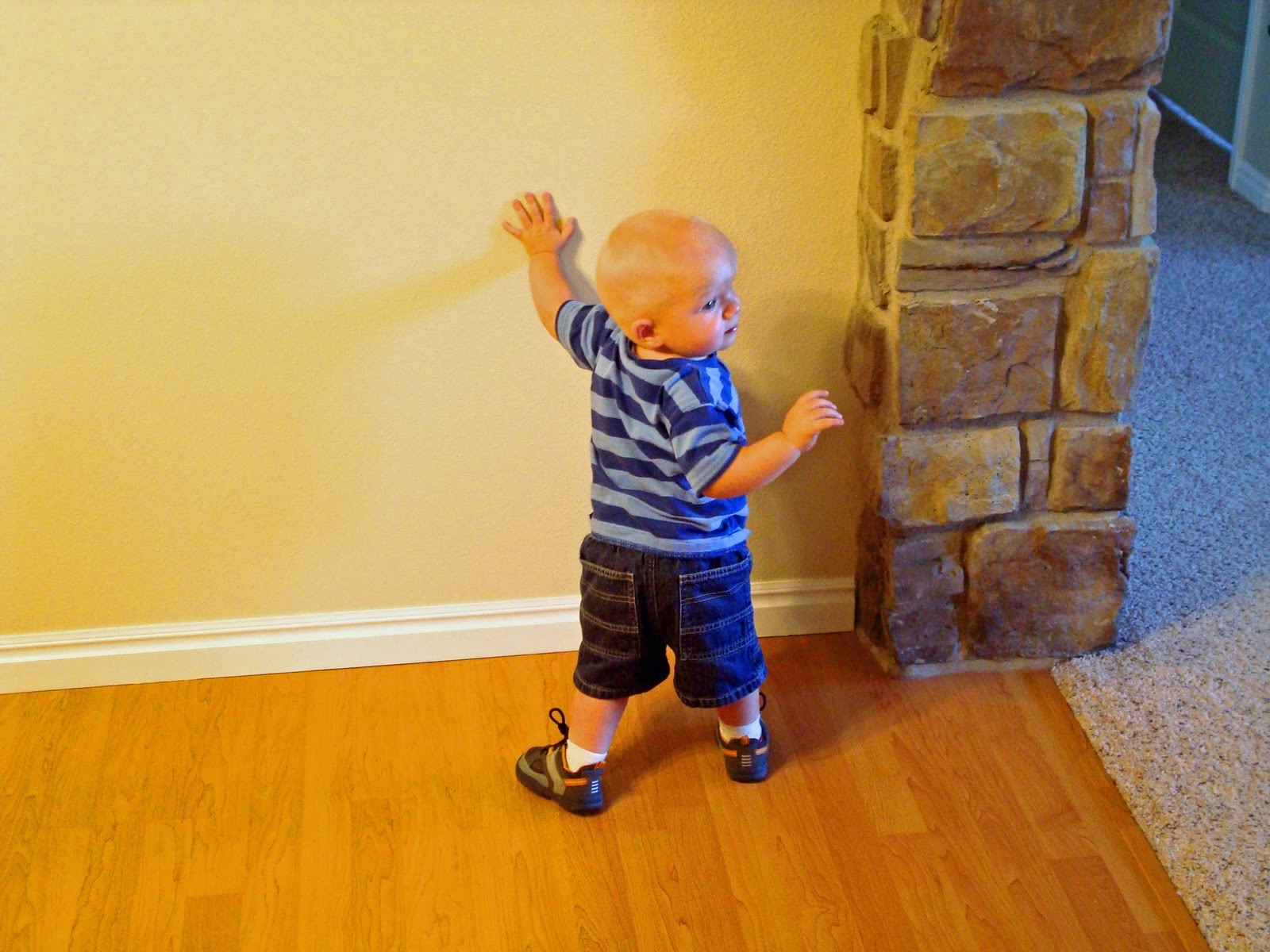
- Spend a lot of time standing and playing at a chest high surface
- Stand with back support (against a couch)
- Stand facing a flat surface (fridge, wall or cabinet) so trunk is not supported.
- Stand in the middle of the room holding onto a common toy.

Cruising (9-13 months)
Child will:
- cruise at different surfaces - starting with chest high

Encourage cruising by:
- moving a toy farther away, forcing them to move to it
- shift weight at their hips to encourage leg movement
- remember to help child to cruise in both directions

Cruising Gaps
Ecourage by:
- starting with furniture together or very close to build confidence
- increase gaps as able
- set up cruising opportunities if there aren't any already (use a kitchen chair, ottoman, etc).

Walking with Support (10-12 months)
- Once child can balance, hold hands at child's side (no higher than chest).

Encourage by:
- Progressing to one handed support by having child hold a toy (for a short distance).
- Push a push toy, weight it down if needed.
- Push a chair, laundry basket or box
- Walk with an object you hold (like a hoop)

Walking Unsupported (11-13 months) 
Child will:
- walk to a parent or couch and let go for the last 1-2 steps
- stand with back against the couch and then try to step forward from there
- may do better with or without shoes

Early Walking Tips (13-15 months)
 - walk on different surfaces (tile, carpet, grass, cement, sand, mattress)
- walk between surfaces; if indoor use blankets, pillows, cushions, etc.
- walk wearing big shoes

Early Walking
 - walk up or down small inclines or curbs
- carry light toys or pull toys on a string

Standing from the Ground Without Support (12-15 months)
 Child will:
- get onto hands and feet and push up into standing
- more mature pattern is to go into a half kneel and push from the floor to stand

Encourage by:
- putting their hands on a slightly higher surface like a cushion, box or bench

Backwards and Sideways Walking (14-15 months)
Encourage by:
- playing "Ring around the Rosie" to walk sideways
- pull a toy on a string to walk backwards
- walk backwards away from getting tickled
- rearrange furniture so that you have to walk sideways to get through
- you push a box while child pulls and walks backwards

Rapid Walking/Running (14-18 months)
Encourage by:
- holding childs hand and pulling him to encourage a faster walk
- play chase
- "run" down a small incline (this encourages a rapid walk)

Walking Upstairs With One Hand Held (17-19 months)
 Encourage by:
- trying to step up onto a small curb, box or stool
- showing them how to hold onto a rail or wall
- not always holding the same side

Alternating feet is not important at this stage.
Kids may lead with the opposite leg of the hand you are holding onto.

Walking Upstairs Alone (24-25 months) and Alternating Feet (30-34 months)
Encourage by:
- starting with a curb or small step stool to practice stepping up unsupported and build strength
- to alternate feet start with physical support and a lot of verbal cues
- put red and green stickers on each foot and match them to red and green cut outs you put on the stairs
Walking Downstairs with a Rail (24-26 months) and Alone (25-27 months)
Encourage by:
- starting with a curb, a few stairs or a child size stair case
- you can stand in front and hold one or both hands, remember not to show a worried face
- place childs hand on the wall so that they use it for support

Kicking a Ball (18-24 months)
- start with a large lightweight ball like a beach ball
- start by walking into a ball and then encourage kicking when standing still
- remember to use both feet

Running "Fairly Well" (18-24 months)
- arms should swing in alternate pattern with legs
- both feet are leaving the ground
- pull holding onto a hand to encourage a faster pace or chase

Climbing Onto an Adult Chair (18-21 months)
- a couch is the easiest, then a chair with arms, then a kitchen chair
- you can start by stepping onto a slightly higher surface like a bench or box or taking a cushion off
- help them raise one leg up, then hold it there

 Picking Up a Toy from the Floor (19-24 months)
 - start with picking up a toy from a slightly higher surface (cushion, bench, box or your hand)
- make sure the child is bending his knees to sqaut

Jumping in Place (22-30 months)
Encourage by:
- bouncing to music and encourage knee bending
- jumping on a trampoline, a mattress while holding onto the headboard, the crib holding onto a rail, or the sofa holding onto the back
- wait for child to initiate the jump and then help so that feet leave the ground

Jumping
 - jump to pop bubbles, bubble wrap, or jump into or out of a hoop
- jump off of a small step, curb or box; hold hands and help both feet leave the ground if the child is stepping down
- watch "tigger" videos, sing jumping songs

Standing on Tiptoes (23-25 months) and Walking on Tiptoes (25-30 months)
Child will:
- reach up for a toy on the counter, a picture on a wall or a ball you are holding

Encourage by:
- holding hands and pulling up to encourage getting onto tiptoes
- pretend games - tiptoe past the sleeping dolls, pretend to "grow"

Walking with More Mature Gait (23-30 months)
- walk between lines that are drawn or taped on the ground (they should get as narrow as 8" apart)
- walk on a plank of wood
- walk along a long piece of toilet paper

Catching a Ball (24-26 months)
- blow bubbles and have child try and "catch" or pop those that are blown towards them (start in sitting position so balance is not an issue)
- encourage child to trap ball against body
- catch a large balloon, light beah ball or gurdy ball
- start closely placing the ball in childs hand and then move further back

Running with Control (24-30 months)
- play chase around a large obstacle in the room (chair, trash can or a tree outside)
- gradually decrease the size of the obstacle to the size of a book, increase the number of obstacles
- play "red light, green light" to stop quickly

Balancing on One Foot Briefly (24-30 months) and for 5 Seconds (30-36 months)
- stomp on bubbles or bubble wrap
- stand to put on an adult's shoe without assistance or while getting dressed
- play "Simon Says"
- kick a ball
- walk up stairs with support
- put a ladder on the floor and step over the rungs
- try to lift up a bean bag that is placed on the foot

Riding a Tricycle (32-36 months)
- find a trike that allows the child's feet to reach the pedals and has a long lever arm
- strap in feet if they do not stay on the pedals
- push the trike with feet on the pedals so that child feels how the pedals move, start on a small incline

General Motor Planning
- encourage playing in new ways so that the child has to problem solve to do the task (go to a park)
- climb over small obstacles (like the ledge into the ball pit) or onto something unstable (platform swing)
- use play equipment for combining activities like crawling in tunnels, climbing, sliding and jumping

Red Flags - When to Consult with a Physical Therapist
- neglect of one side of the body - strong favoring of one arm or leg or leading with one leg
- not pulling to stand by 11 months or walking by 17 months
- can't stand without furniture 1-2 months after walking
- up on toes more than 50% of the time
- severe in-toeing or out-toeing that doesn't correct with time
- severely "flat" feet (pronated)
- clumsiness is so severe that it effects function